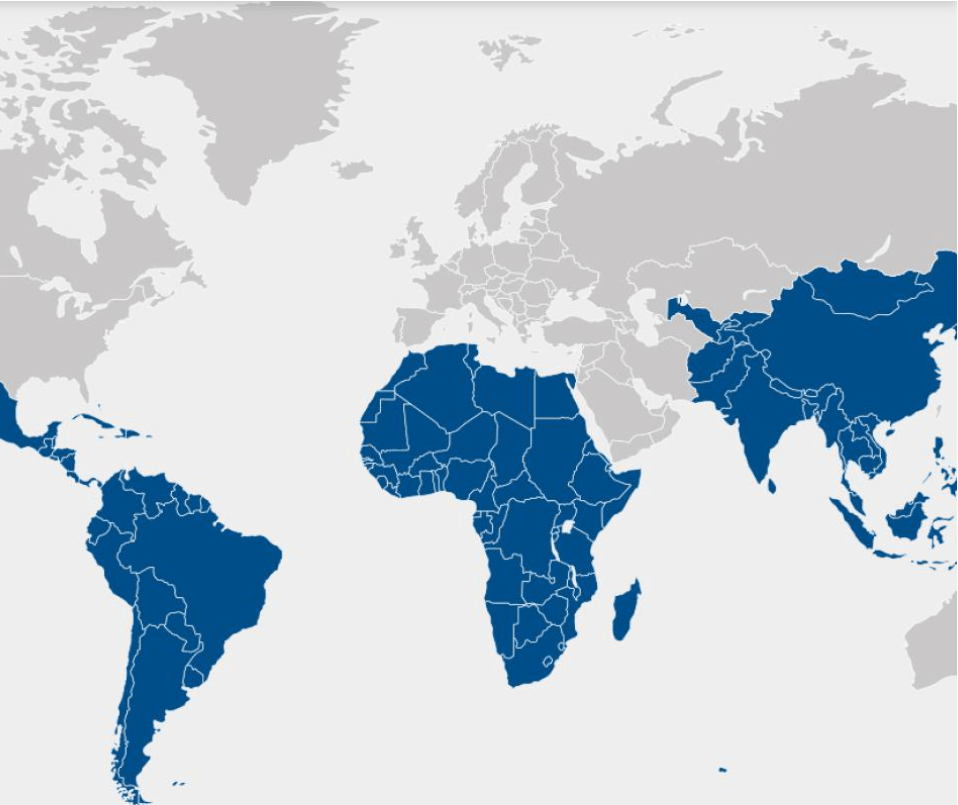
In recent years, I have noticed that donor interest in South-South collaboration has grown significantly. Foundations, bilateral agencies, and multilateral institutions are funding programs that aim to transfer solutions, and enterprises from one country to another. The intent is to leverage shared development experience and build peer-to-peer learning across the Global South. The design, however, sometimes falls short of that intent. This piece is an attempt to think through what better design might look like.
The term itself is broken and that matters for the design of the program
The first design gap in South-South collaboration begins with the label itself. The term first emerged at the United Nations Conference on Trade and Development in the 1960s and came into its own after the New International Economic Order declaration in 1974. The United Nations created an office for South-South cooperation in 1978. The intention was to create a framework for solidarity and mutual support among nations that shared a history of colonialism and economic marginalization.
Almost five decades later the term feels outdated and imprecise. The Global South is neither geographically accurate nor economically coherent. Australia is geographically in the south but considered part of the Global North. China frequently described as part of the Global South is the world’s second largest economy, a major global power, and a global manufacturing and investment giant. India competes with several global south economies in manufacturing and trade.
Using a single label for such diverse countries creates a binary that does not reflect today’s world. When we design South-South collaboration programs on the assumption that Global South countries share context we sometimes skip the country-specific analysis that any program needs to work. The label replaces the analytical work and evidences, and that is where the design failure begins.
An outsider’s approach
Before designing a South-South collaboration program, we need to understand one structural reality: the outsider vs insider problem does not change because both the countries are from global south.
The premise of South-South collaboration is that countries grouped under the Global South share common challenges and therefore common solutions. They do not. A smallholder rice farmer in Uttar Pradesh and a smallholder maize farmer in Malawi face different soil conditions, market structures, policy environments, and institutional realities. The fact that both live in what we call the Global South tells us almost nothing useful about what solutions will work for either of them.
As I wrote about in the context of Indian agtech, thousands of farmers are onboarded during a funded project, and engagement disappears the moment donor support ends. South-South programs often suffer from the same dynamic. The solution arrives with a program, gets adopted because it costs nothing and might lead somewhere, and then quietly stops when the funding runs out. The same problem with a different nationality.
This brings me to William Easterly’s insider versus outsider argument. He argues that development fails when outsiders attempt to impose top-down, one-size-fits-all blueprints on communities, rather than relying on the bottom-up, local knowledge of insiders. An Indian enterprise operating in Kenya is still an outsider even if both countries may sit under the same Global South label. I want to highlight one specific risk in South-South collaboration. When a expert from global north arrives in a global south country, it is assumed that they will not be aware of the local context. However, when an Indian enterprise arrives in Kenya both parties often assume shared context because of the Global South label. That assumption of similarity without actual similarity is more damaging.
The Kenya agtech example- what will work and what will not
The agtech sector in Kenya comprises 186 companies, including 49 funded companies that have collectively raised USD 153 million in venture capital and private equity. Seven of these are Series A funded or above. These are not early-stage startups looking for solutions from outside. They are companies built by Kenyan entrepreneurs who understand Kenyan farmers, markets, and regulatory environments. They have raised serious capital and have local relationships that took years to build.
What will not work: When we try to parachute an agtech from outside into Kenya through a South-South collaboration program, it is not filling a gap. It is creating competition with local players who are better placed to solve the problem. The acceptability of the outside solution might be lower within different stakeholders. And when the program ends, the Kenyan agtech ecosystem will be exactly where it was except with a few thousand farmers who have once again seen a solution arrive and leave.
What will work: I think the Kenyan agtech ecosystem needs access to global networks, patient capital, and knowledge about what has worked and failed elsewhere. An agtech that comes as a knowledge partner rather than a solution provider adds genuine value. One that shares its experience of scaling FPO-linked digital advisory, or navigating government livelihoods program partnerships, or structuring outcome-based pricing and lets Kenyan players build their own version is genuinely useful. A practical model for this exists: an enterprise partners with a Kenyan counterpart, contributes its technology and learning, and the Kenyan partner owns the market relationship. The Indian partner gains market knowledge and a sustainable revenue stream. The Kenyan partner gains technology, global networks, and capital.
South-South collaboration can work
The argument here is not that South-South collaboration is inherently impossible. It is that the way it is currently structured, in some cases, which is solution transfer through donor-funded program needs to be redesigned.
I think the green revolution is one of the strongest examples where similar collaboration worked.
Norman Borlaug developed high-yield wheat varieties at the International Maize and Wheat Improvement Center in Mexico in the 1940s and 1950s. In 1960s, India imported 18,000 tons of Mexican wheat seeds. Wheat output in India almost doubled in next five years. By the mid-1970s India was self-sufficient in food production.
What made it work was the transfer of technology, the seeds and the knowledge. The Indian government requested it, owned it, and built a national program around it. M.S. Swaminathan led the Indian side. The outsider brought the knowledge, and the insider built the system.
The corporate world has a version of this model too. India has many examples such as Hero Honda, Maruti Suzuki among others. A foreign partner brought technology, capital, and global knowledge. A local partner brought market understanding, relationships, and contextual intelligence. No one replaced the other and both were better off.
This is the model South-South collaboration needs to follow. Genuine partnership where the outsider brings knowledge, networks, and capital, and the insider builds the solution.
I want to acknowledge here that the examples above are not technically South-South examples- Borlaug was American, CIMMYT was funded by the Rockefeller Foundation, and Honda and Suzuki are Japanese companies. But the principle they demonstrate which is transfer knowledge, let the insider build the system, structure genuine partnerships with shared ownership is exactly what South-South collaboration should support.
How donors should design South-South programs
In my experience, to promote South-South collaboration three principles need to be followed:
- Transfer knowledge not organizations: The Green Revolution transferred seeds and scientific knowledge and let India build its own institutions around them. When we want to bring enterprise from one country to another country in global south, the question to ask is: what knowledge, networks, skills can we transfer that local players cannot generate themselves? If the answer is nothing, then the program should not exist. The goal should be to strengthen the capacity of local players to scale their own solutions.
- Be an enabler: The Kenyan agtech ecosystem needs access to global networks, patient capital, knowledge about what has worked and failed elsewhere. An outside enterprise that comes as an enabler opening doors, sharing evidence, providing capital adds genuine value. Outside enterprises that contribute knowledge and capability should be supported for that contribution. The measure of success for any donor-funded South-South collaboration should be how much stronger the local ecosystem is when the program ends.
- Follow the joint venture model: Hero Honda and Maruti Suzuki worked because they were genuine partnerships. When South-South collaboration is structured as a joint venture with shared risk, shared ownership, and shared outcomes, it has a chance of working. When it is structured as a program, a deliverer, and a beneficiary- it almost never does.
I understand that these are not exhaustive and every country context, sector, and partnership will surface its own design considerations. What matters is that we ask the right questions before designing and not after the program has already been funded and the logframe has already been written.
A final thought
I think gone are the days when outside experts from the North or the South could arrive with general advice and expect it to be received as wisdom. Communities, governments, and local enterprises across the Global South have built real capability. They understand their contexts and have their own solutions.
However, I strongly believe that the opportunity for South-South collaboration is real. The shared experience of navigating development challenges, building farmer institutions, designing climate finance instruments, scaling digital agriculture is genuinely valuable and transferable. But it should transfer as knowledge, and partnership.
For donors designing South-South programs- one question is worth asking at the design stage: when this program ends, will the local ecosystem be stronger than it was before we arrived? If the honest answer is no, then the program needs to be redesigned.
Disclaimer: The ideas and observations in this piece are entirely my own. I used AI to help structure them.
 Shivanshu Sharma
Leave a comment